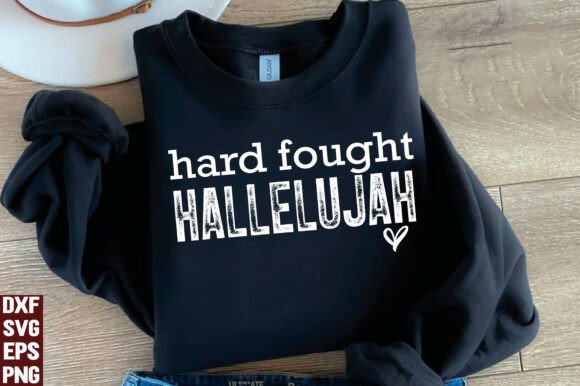
Hard Fought Hallelujah
A Design That Breathes Before the Needle Moves
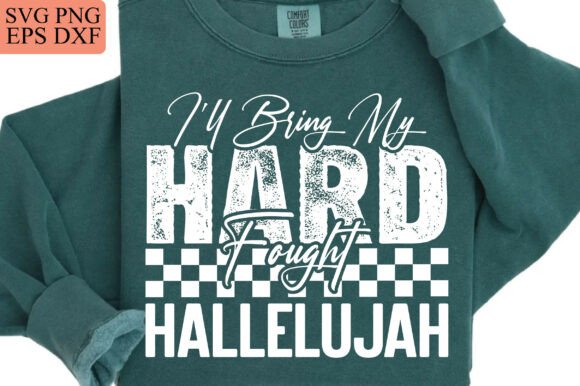
When I first opened Christian Svg, Hard Fought Hallelujah, I didn’t scan for file formats or stitch counts—I paused. There’s a quiet gravity in the lettering: slightly uneven baseline, soft serif weight, and subtle curvature in the “H” and “L” that feels handwritten but not fragile. It’s not flashy gospel—it’s grounded. The phrase itself carries weight, and the design honors that without leaning into cliché. No doves, no crosses layered over text, no forced flourishes. Just clean, reverent typography with room to breathe. That tells me right away this isn’t meant for a crowded sleeve or a tiny pocket—it wants space, intention, and fabric that lets it settle.
Where It Lives Best: Real Projects, Not Just Pixels
Last week, I used Christian Svg, Hard Fought Hallelujah on a natural linen tote bag for a local church’s women’s retreat—no branding, no logo, just the phrase centered on the front panel. It stitched cleanly at 4.5" wide, with moderate stitch density and no dense fill areas. The result? Calm, confident, and deeply personal. Customers didn’t just grab a bag—they paused, read it aloud, smiled quietly. That’s the power of restraint done well.
It shines on mid-weight fabrics where texture supports, rather than competes with, the design: heavyweight cotton sweatshirts (especially charcoal or oatmeal), canvas aprons for faith-based bakeries, tea towels for kitchen blessings, and nursery pillow covers where softness matters more than sparkle. As a t-shirt design, it works best on relaxed-fit tees with room across the chest—not tight athletic cuts where stretched fabric distorts letter spacing. For baby embroidery? Yes—but size it down thoughtfully (no smaller than 3") and avoid satin-stitched outlines that could irritate delicate skin.
Where to Pause—and Test First
This isn’t a “drop-and-stitch” design for every surface. On highly textured fabrics like bouclé or thick terry cloth, the subtlety of the letterforms can blur—those gentle curves lose definition. Stretchy knits demand extra stabilization; without it, the “fought” portion can ghost or pull. Dark fabrics require high-contrast thread—navy or black thread on charcoal fleece reads beautifully, but off-white on deep burgundy needs testing. And curved surfaces? Caps or beanies are possible, but only if you’re willing to adjust placement to avoid distortion near the crown seam.
I also watched how small details held up during stitching: the crossbar in the “A”, the slight taper on the “L” legs, the negative space inside the “O”. All stayed legible at standard embroidery scale—but shrink it below 2.75", and those nuances collapse. So for patches or tiny labels? Choose a simplified version—or skip it entirely. This is a design that earns its presence, not one that shouts from a distance.
What It Adds to Your Finished Product—Beyond Aesthetics
Christian Svg, Hard Fought Hallelujah elevates perceived value because it feels considered—not templated. When customers see it on a handmade product, they sense care in selection, not just speed in execution. That builds trust, especially for Etsy sellers or boutique owners who rely on emotional resonance over mass appeal. It aligns seamlessly with brands rooted in authenticity: faith-centered craft businesses, grief-support gift shops, adoption agencies offering keepsake blankets, or even wedding planners curating “first anniversary” embroidered pillows.
It also performs well in digital spaces. In printable mockups, it reads clearly against neutral backgrounds—no need for drop shadows or outlines. On light and dark fabric previews, it maintains legibility with minimal color tweaks. That’s rare for text-heavy embroidery files and makes listing creation faster for digital embroidery file sellers.
Practical Notes from My Hoop
- Always test first—on scrap fabric matching your final project’s weight and stretch. Run it at full speed once, then slow down to watch how corners and curves stitch.
- Check thread color contrast before hooping. What looks rich on screen may mute on fabric—especially matte cotton or heathered blends.
- Review stitch density. If your machine flags heavy underlay or overlapping satin stitches, simplify or reduce density—this design doesn’t need visual noise to land.
- Confirm hoop size before digitizing or purchasing. While it scales well, extremely narrow hoops (<3") will force compromises in spacing and clarity.
- Inspect small details in your embroidery software—especially junctions between letters. Some versions of this phrase have tight kerning that may cause thread breaks if not optimized.
- Test black-and-white mockups to assess readability without color bias—critical for inclusive design and accessibility.
- Use proper stabilizer: medium-cutaway for knits, tear-away for stable wovens. Skip lightweight fusibles—they won’t support the structure this phrase needs.
- Verify licensing before selling finished items or reselling the digital embroidery file. Not all Christian-themed designs include commercial use rights—even if labeled for “personal and small business.”
Not Just Faith—But Fit
As an embroidery designer who’s reviewed hundreds of Christian-themed files, I’ll say this plainly: Christian Svg, Hard Fought Hallelujah stands out not because it’s sacred, but because it’s well-made. It respects the material, the machine, and the person receiving the finished product. It doesn’t try to be everything—it knows its voice, its scale, and its place. Whether you’re stitching a holiday embroidery gift for a grieving friend, building a cohesive line of boutique apparel, or creating custom embroidered patches for a youth group, this design delivers sincerity without sentimentality.
That’s why it’s earned space in my go-to folder—not as filler, but as foundation.